Observation culture
Learning development is understood through careful, longitudinal and context-sensitive observation.
International astrophysics, scientific evaluation at reference level, and the transfer of rigorous observation standards into educational innovation.
AstroMum is grounded in international scientific work in astrophysics, quantitative spectroscopy, stellar atmospheres and present-day cosmic abundance standards.
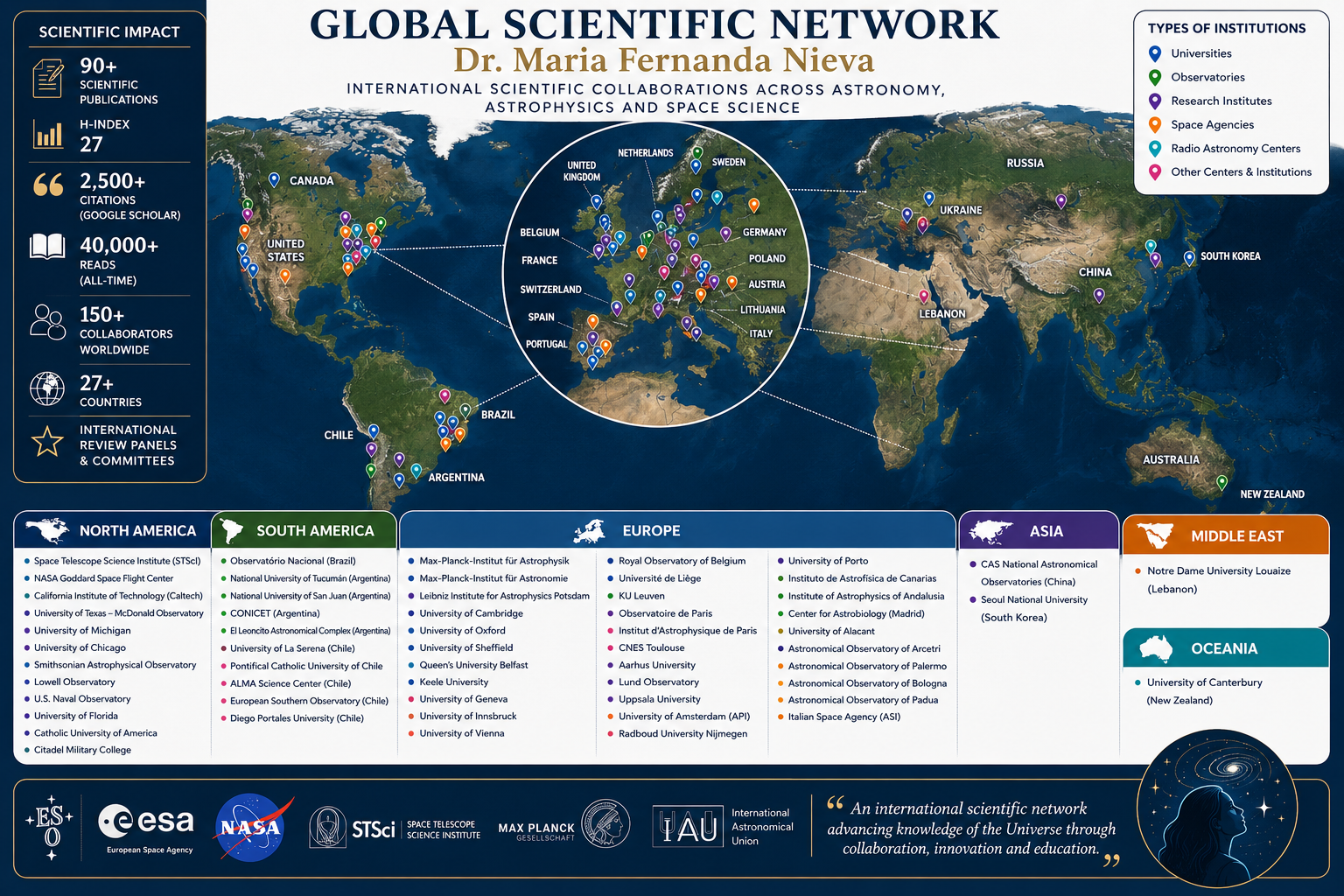
The publication network visualizes an international research profile shaped by collaborations across universities, observatories, research institutes, space agencies and scientific organisations.
A contribution to resolving a historical problem in astrophysics that led to the establishment of a new present-day cosmic abundance standard.
For generations, astrophysics faced a complex calibration problem involving many interdependent variables. Different observational methods and modelling assumptions produced abundance scales that were difficult to reconcile.
Through high-precision spectroscopy, improved stellar atmosphere modelling and rigorous uncertainty control, this work contributed to a more self-consistent understanding of the chemical composition of the local universe.
The achievement was methodological as much as observational: revealing hidden structure in a complex system through precision, modelling and evidence-based judgement.
Explore the scientific transferScientific work at high level is not judged only by final results. It is judged by the quality of the question, the adequacy of the model, the strength of the evidence, the coherence of the argument and the capacity to reflect on uncertainty and limitations (Nieva 2026, in prep.).
In Hubble and ESO proposal evaluation and in international peer review, excellence is assessed through the quality of thinking: how a problem is formulated, modelled, argued, represented and communicated. This is the same cognitive architecture described in mathematics education as process-oriented competencies (Nieva 2026, in prep.).
This table makes the transfer visible: the same cognitive architecture that supports rigorous scientific evaluation also supports deep mathematical learning (Nieva 2026, in prep.).
| Scientific evaluation practice | Process-oriented competency | Educational meaning |
|---|---|---|
| Formulating and evaluating unresolved scientific questions | Problem solving | Approaching unfamiliar situations with strategies, persistence and structured thinking. |
| Assessing the adequacy of theoretical and observational models | Modelling | Connecting real situations with conceptual and mathematical representations. |
| Testing evidence, assumptions and conclusions | Reasoning and argumentation | Justifying conclusions and making thinking transparent. |
| Presenting complex results in structured scientific form | Representation | Making thinking visible through diagrams, symbols and structured forms. |
| Engaging in peer review, panel discussion and international collaboration | Communication | Explaining, questioning, revising and developing shared understanding. |
Educational systems often assess outcomes. Scientific evaluation assesses thinking processes. This distinction is central for designing learning environments, observation tools and teacher education formats that make development visible (Nieva 2026, in prep.).
Learning development is understood through careful, longitudinal and context-sensitive observation.
Process-oriented competencies become observable, discussable and useful for adaptive pedagogical decisions.
Scientific thinking becomes connected with movement, nature, real-world participation and human development.
AstroMum connects world-class scientific experience with educational innovation. The goal is to transfer rigorous observation, modelling, argumentation and reflective judgement into schools, teacher education and future-oriented learning environments.