Original paper
The full peer-reviewed article in Astronomy & Astrophysics.
Open paperA public-facing explanation of how young stars helped define the chemical composition of our local Galaxy today.
The full peer-reviewed article in Astronomy & Astrophysics.
Open paperA visual explanation of the scientific argument and its broader meaning.
Open presentationAn audio version for a broader audience: “The Sun is a cosmic immigrant”.
Open audioThe full presentation gives a compact visual narrative: why cosmic reference standards matter, why young B-type stars are ideal, how the method works, and what the results mean.
To understand stars, planets and galaxies, scientists need reference values for chemical elements: how much carbon, oxygen, iron or magnesium is present in cosmic matter. For a long time, the Sun was used as the main reference. But the Sun is 4.56 billion years old. It does not necessarily tell us what the local Galaxy is made of today.
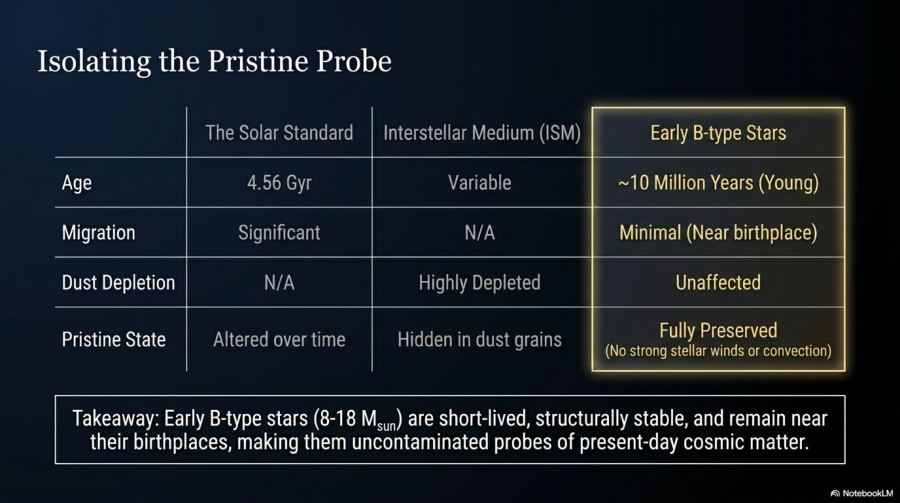
This study looked instead at young, nearby B-type stars. They are massive, bright and short-lived, so they still preserve the chemical fingerprint of the gas cloud from which they were born.
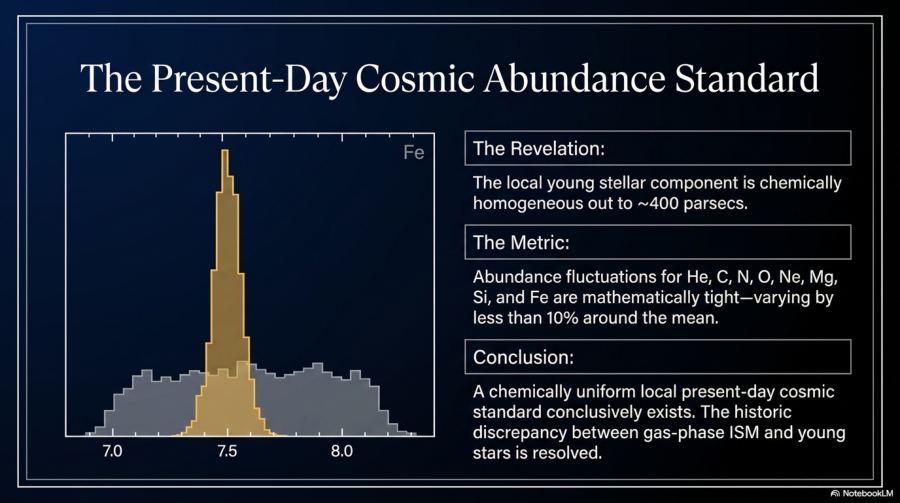
The paper established a present-day cosmic abundance standard for the solar neighbourhood. In simple terms: it provided a more precise chemical “baseline” for what nearby cosmic matter looks like now, not billions of years ago.
This matters for models of stellar evolution, Galactic chemical evolution and interstellar dust. It also led to a striking conclusion: the Sun likely formed closer to the Galactic centre and later migrated outward — becoming, in this sense, a cosmic immigrant.
Early B-type stars preserve the present-day chemical composition of their birth environment.
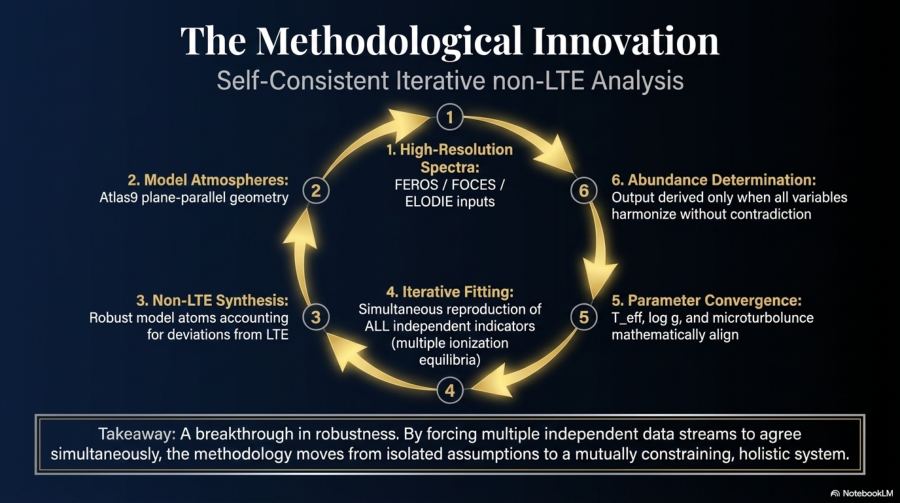
The study used detailed stellar spectra and non-LTE modelling to reduce systematic errors.
The result is a precise abundance standard for key elements near the Sun.
Stars do not directly tell us their chemical composition. Scientists infer it from light, models and consistency checks. This is why the paper is not only about astrophysics; it is also about how reliable knowledge is built in complex systems: by combining careful observation, mathematical modelling, uncertainty awareness and repeated validation.